Monday, May 19, 2014

Quiz for May 2014
Photoropism
Phototropism is the growth of organisms in response to light.
It is most often observed in plants, but can also occur in other
organisms such as fungi.
The growth or movement of a plant part in response to a source of
light. The cells on the plant that are farthest from the light have a
chemical called auxin
that reacts when phototropism occurs.
This causes the plant to have elongated cells on the farthest side from the light. Phototropism is one of the many plant tropisms or movements which respond to external stimuli. Growth towards a light source is called positive phototropism, while growth away from light is called negative phototropism. Most plant shoots exhibit positive phototropism, and rearrange their chloroplasts in the leaves to maximize photosynthetic energy and promote growth.[1][2]
Roots usually exhibit negative phototropism, although gravitropism may play a larger role in root behavior and growth. Some vine shoot tips exhibit negative phototropism, which allows them to grow towards dark, solid objects and climb them. The combination of phototropism and gravitropism allow plants to grow in the correct direction.[3]
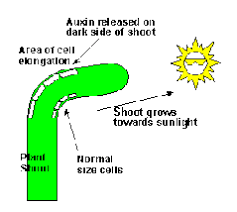

This causes the plant to have elongated cells on the farthest side from the light. Phototropism is one of the many plant tropisms or movements which respond to external stimuli. Growth towards a light source is called positive phototropism, while growth away from light is called negative phototropism. Most plant shoots exhibit positive phototropism, and rearrange their chloroplasts in the leaves to maximize photosynthetic energy and promote growth.[1][2]
Roots usually exhibit negative phototropism, although gravitropism may play a larger role in root behavior and growth. Some vine shoot tips exhibit negative phototropism, which allows them to grow towards dark, solid objects and climb them. The combination of phototropism and gravitropism allow plants to grow in the correct direction.[3]
What is tropism?
Plant and Response
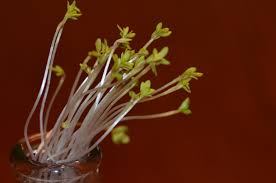
Plant use direct environmental stimuli for orientation in growth and movement. this is called TROPISM. The responses of the plant may be toward (positive response) or away (negative response) from the external stimuli or stimulus.
Plants are able to respond to various different kinds of external environmental stimuli such as chemical in the soil, light, water, gravity and others. The growth movements are named according to the stimulus.
Plant use direct environmental stimuli for orientation in growth and movement. this is called TROPISM. The responses of the plant may be toward (positive response) or away (negative response) from the external stimuli or stimulus.
Plants are able to respond to various different kinds of external environmental stimuli such as chemical in the soil, light, water, gravity and others. The growth movements are named according to the stimulus.
- Photoropism- reaction to light and different wavelenghts
- Heliotropism- reaction to sunlight intensity and direction
- Photoperiodism- reaction to the length of light and dark periods
- Gravitropism- reaction to gravity
- Hydrotropism- reaction to moisture gradient (water)
- Thigmotropism- reaction to touch
- Thermotropism- reaction to temperature
- Chemotropism- reaction to chemicals
 | |||||
| Phototropism |
 | |
| Thigmotropism |
| Hydrotropism |
 |
| Geotropism |
Subscribe to:
Comments (Atom)